In the rapidly evolving education landscape, digital tools and social media have emerged as pivotal elements in transforming classroom communication. This revolution is altering how educators teach and students learn and redefining engagement, collaboration, and information dissemination parameters. Integrating these technologies into educational settings has facilitated a more interactive, flexible, and student-centered approach to learning, enabling communication to transcend the physical boundaries of traditional classrooms.
Digital tools- ranging from educational apps and platforms to interactive whiteboards and learning management systems- provide dynamic resources for teaching and assessment, making learning more engaging and accessible. They offer diverse means to present information, cater to different learning styles, and allow students to progress at their own pace. Meanwhile, social media platforms have become powerful channels for fostering collaboration and community among students, educators, and the wider academic community. They enable real-time communication, peer support, and the sharing ideas and resources across vast networks.
These technologies have enriched classroom communication by facilitating immediate feedback, enhancing student participation, and opening up global learning opportunities. As we navigate this digital era, the thoughtful integration of digital tools and social media in education promises to empower teachers further and inspire learners, paving the way for more innovative, inclusive, and effective teaching and learning practices.
1.1 Concept of Digital Tools.
Digital tools refer to various software, applications, and online platforms designed to support and enhance various tasks across multiple domains, including education, business, design, and personal productivity. These tools leverage the power of modern technology to enable users to accomplish tasks with greater efficiency, effectiveness, and creativity than traditional methods. Digital tools can range from simple applications, such as calculators and note-taking apps, to complex software systems, like database management platforms and comprehensive learning management systems. They are characterized by their accessibility, allowing users to engage with them across multiple devices and locations, and their functionality, including everything from communication and collaboration to data analysis and content creation. Digital tools are integral to the digital transformation of societies, empowering individuals to learn, communicate, create, and manage tasks in previously unimaginable ways. As such, they play a crucial role in enhancing productivity, fostering creativity, and facilitating learning and personal development in the digital age.
1.2 What is Social Media?
Social media encompasses various online platforms and applications designed to foster user interaction, collaboration, and content sharing. These platforms empower individuals to create, share, and engage with content, including text posts, images, videos, and audio, forming virtual communities and networks. Central to social media is its interactivity; it thrives on user participation through comments, likes, shares, and other forms of feedback, facilitating a dynamic exchange of ideas and information. Social media platforms are unique in their ability to connect people across the globe, breaking down geographical barriers and enabling users to maintain personal and professional relationships in a digital space. They are tailored to provide personalized experiences, recommending content and connections based on individual preferences and behaviors. This digital ecosystem has become integral to modern communication, significantly influencing how information is disseminated, how connections are forged, and how individuals and organizations establish online identities.
Here are examples of popular social media platforms, each serving unique purposes and audiences:
- Facebook: A comprehensive social networking site that allows users to share posts, photos, videos, and links, engage in messaging, join groups, and participate in community events. It caters to a broad demographic and is used for personal connections and business marketing.
- Twitter: Known for its microblogging feature, Twitter allows users to post short messages called tweets, enabling quick sharing of news, thoughts, and updates. It’s popular for real-time discussions and is widely used by individuals, celebrities, and organizations for outreach and engagement.
- Instagram: A photo and video-sharing app that emphasizes visual content, including stories and live streaming. Instagram is popular among younger audiences and is extensively used for personal expression, influencer marketing, and brand promotion.
- LinkedIn: A professional networking platform designed for career development, professional connections, job searching, and industry discussions. Users can share their professional experiences, achievements, and articles related to their field.
- TikTok: A short-form video platform where users create and share videos ranging from 15 seconds to three minutes. It’s known for its entertainment value and creative content and has a significant influence among younger demographics.
- Snapchat: A multimedia messaging app famous for its ephemeral content- photos and videos that disappear after being viewed. It’s popular for its filter stories and offering a more private form of social sharing among friends.
- Pinterest: A visual discovery engine where users can find ideas like recipes, home and style inspiration, and more. Users can save and categorize images and videos (pins) on different boards for various interests.
- YouTube: The largest video-sharing platform where users can upload, share, and view videos. It serves a wide range of content creators and viewers with videos on education, entertainment, how-tos, and much more.
1.3 Positive Effects of Digital Tools and Social Media on Classroom Communication.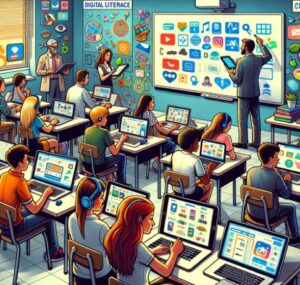
Digital tools and social media have ushered in a new era of classroom communication, transforming the traditional educational landscape into a dynamic, interactive, and globally connected environment. This technological integration extends beyond merely enhancing the delivery of instruction; it fundamentally enriches the learning experience, fostering deeper engagement, collaboration, and accessibility. The positive effects of these digital innovations are manifold, ranging from facilitating personalized learning journeys to fostering global connections and cultural exchanges. They empower students with many resources, encouraging a more active and self-directed approach to learning. Moreover, these tools have redefined the roles of educators, enabling them to adopt more facilitative approaches that leverage real-time feedback, multimedia resources, and collaborative projects to stimulate student interest and participation.
Integrating digital tools and social media into classroom communication has brought about many positive effects that enhance both teaching and learning experiences. These technologies have transformed traditional educational practices and opened up new avenues for engagement, collaboration, and accessibility. Here are some of the key positive effects:
- Enhancing Engagement and Interaction: One of the most significant benefits of incorporating digital tools and social media into the classroom is increased student engagement and interaction. Interactive presentations, educational apps, and gamified learning platforms have introduced new dimensions to learning that capture students’ attention in ways textbooks never could. This interactivity makes learning more enjoyable, improves retention rates, and encourages active participation from all students, including those who may be shy or less likely to engage in traditional classroom settings.
- Accessibility of Educational Resources: Digital tools have democratized access to educational resources, ensuring that learning is not confined within the walls of a classroom. Students can access lectures, readings, and assignments anytime and from any location, allowing for a more flexible and inclusive educational experience. This accessibility is particularly beneficial for students with disabilities or those who live in remote areas, as it provides them with the same opportunities for learning as their peers.
- Fostering Collaboration and Peer Learning: The collaborative nature of many digital tools and social media platforms has made peer learning and teamwork more accessible and effective. Platforms like Google Docs, Slack, and educational forums enable students to collaborate on projects, share resources, and provide real-time feedback, regardless of their physical location. This collaboration enhances learning outcomes and helps students develop vital teamwork and communication skills.
- Streamlining Communication: Digital tools and social media have streamlined communication between teachers and students, making it easier and faster to share information, clarify doubts, and provide feedback. Teachers can quickly disseminate announcements, resources, and assignments through learning management systems (LMS) or social media groups, ensuring that all students are up-to-date with the latest information. Additionally, these platforms offer various channels for students to ask questions and seek help, promoting a more supportive learning environment.
- Personalizing Learning Experiences: Using digital tools in education allows for a more personalized learning experience. Teachers can use these technologies to cater to different learning styles, needs, and paces, providing customized resources and assignments that match each student’s unique learning profile. This personalization ensures that every student can learn in the way that suits them best, leading to better outcomes and a more satisfying educational experience.
- Developing Digital Literacy: Integrating digital tools and social media into classroom communication enhances learning and helps students develop essential digital literacy skills. Navigating online resources, assessing the credibility of information, and understanding digital etiquette are critical competencies in today’s digital world. By using these tools in an educational context, students gain valuable experience that prepares them for the complexities of the digital age.
- Encouragement of Critical Thinking and Problem-solving: Digital tools and social media platforms often present scenarios that require critical thinking, analysis, and problem-solving. Students are encouraged to think critically and develop solutions to complex problems through interactive simulations, online debates, and problem-based learning activities. This enhances their academic skills and prepares them for real-world challenges.
- Facilitation of Lifelong Learning: Integrating digital tools into education instills a culture of lifelong learning. With endless resources, students learn how to learn, becoming more self-directed in their educational journeys. This ability to independently seek out information, learn new skills, and adapt to changing technologies is invaluable in today’s fast-paced world.
- Enhancement of Teacher Professional Development: Digital tools and social media also profoundly affect teachers, offering abundant resources for professional development. Teachers can participate in online workshops, webinars, and professional networks, exchanging ideas and strategies with educators worldwide. This improves their teaching practices and keeps them updated on the latest educational technologies and methodologies.
- Eco-friendly and Cost-effective Solutions: Digital classrooms can significantly reduce the need for physical materials, contributing to eco-friendly and cost-effective educational practices. E-books, online assignments, and digital submissions minimize paper usage, supporting environmental sustainability. Moreover, digital resources can be more cost-effective in the long run, reducing the financial burden of textbooks and printed materials on educational institutions and students.
- Encouraging Creative Expression: Digital tools provide a platform for creative expression, allowing students to showcase their work through blogs, digital portfolios, and social media. These platforms give students a voice and an audience, fostering a sense of pride and accomplishment in their work. Encouraging creative expression enhances students’ creativity and boosts their confidence and engagement with the learning material.
The positive effects of digital tools and social media on classroom communication are profound, offering students and teachers innovative ways to engage, interact, and learn. As technology continues to evolve, so will the possibilities for its application in education, promising even more exciting developments in how we teach and learn. Embracing these tools can enhance the educational experience, making learning more accessible, engaging, and tailored to meet the diverse needs of students.
1.4 Negative Effects of Digital Tools and Social Media on Classroom Communication.
While digital tools and social media have transformed classroom communication with numerous positive effects, their integration into education presents challenges and negative impacts. These issues require careful consideration and management to mitigate their effects on students and the learning environment.
- Distraction and Reduced Focus: One of the most immediate challenges is the potential for distraction. Devices and platforms designed for educational purposes can also give students access to games, social networking, and other non-educational content during class. This access can divert attention from learning activities, reducing focus and engagement with the educational material.
- Overreliance on Technology: There’s a risk that both students and teachers may become overly reliant on digital tools and social media for communication and learning. This overreliance can hinder the development of fundamental skills such as critical thinking, problem-solving, and interpersonal communication. For example, the ease of accessing information online may diminish students’ ability and motivation to learn and remember information or solve problems independently.
- Cyberbullying and Privacy Concerns: The use of social media and digital platforms in education opens up avenues for cyberbullying, exposing students to potential harm and distress. Moreover, privacy concerns arise as personal information and educational data are shared and stored online. Ensuring the security of this information and protecting students from online harassment are significant challenges.
- Digital Divide and Inequality: The digital divide refers to the gap between individuals with access to modern information and communication technology and those without. This divide can exacerbate existing educational inequalities, as students without adequate access to digital tools and high-speed internet are disadvantaged, potentially missing out on educational content and participation in digital learning activities.
- Impact on Social Skills: Excessive use of digital tools and social media can impact students’ social skills and emotional development. Face-to-face interaction is critical in developing empathy, emotional intelligence, and interpersonal communication skills. A heavy emphasis on digital communication might limit these opportunities, affecting students’ ability to engage effectively in real-life social situations.
- Information Overload: The vast amount of online information can lead to information overload, making it difficult for students to discern relevant, credible information from misinformation. This overload can overwhelm students, affecting their ability to concentrate, process information effectively, and make informed decisions.
- Physical and Mental Health Concerns: Extended screen time associated with using digital tools and social media can adversely affect physical and mental health. Physical issues such as eye strain, poor posture, and reduced physical activity are concerns, alongside mental health issues like anxiety, depression, and sleep disturbances stemming from excessive digital engagement.
While digital tools and social media offer transformative potentials for classroom communication, their challenges cannot be overlooked. Addressing these negative effects requires a balanced approach that includes setting clear guidelines for technology use, fostering digital literacy, ensuring equitable access to digital resources, and promoting a healthy balance between digital and real-life interactions.