The concept of green marketing began to gain prominence in the late 1980s (Peattie & Crane, 2005). Green marketing refers to the planning, promotion, pricing, and distribution of products and services in ways that minimize or eliminate negative impacts on the environment. It represents a comprehensive approach aimed at reducing the environmental demands placed by consumers and society while supporting long-term sustainability (Peattie, 1995; Welford, 2000). In this context, green marketing can be understood as a process in which goods and services are produced, processed, and delivered using environmentally responsible practices (Shil, 2012).
An effective green marketing framework must incorporate meaningful changes that generate value not only for consumers but also for society and the natural environment. Providing transparent information about a product’s ecological impact enables consumers to make informed purchasing decisions and can positively influence their buying intentions (Polonsky, 2011). However, there is a common misconception that only products with explicit environmental labels qualify as “green.” Consumers often associate green marketing with terms such as recyclable, refillable, sustainable, ozone-safe, phosphate-free, and eco-friendly.
In the hotel and resort industry, green marketing encompasses a wide range of practices designed to reduce environmental harm. These include implementing energy-saving initiatives through renewable energy use and energy-efficient appliances, reducing water consumption, placing recycling bins in guest rooms, promoting environmentally friendly transportation and carbon offset programs, encouraging the reuse of towels and bed linens, using eco-friendly cleaning products, sourcing food locally, supporting sustainable resort apparel, and offering eco-conscious wellness activities such as sustainable yoga programs (“green marketing practices in hotels – Google Search,” 2021). Consequently, many hotels and resorts now position themselves as eco-friendly or ecotourism destinations, offering tourists opportunities to experience nature while minimizing environmental impact (May, 1991; Ingram & Durst, 1989; Troumbis, 1991).
What Is Green Marketing?
Green marketing refers to the practice of developing, promoting, pricing, and distributing products and services in ways that minimize harm to the natural environment while satisfying consumer needs. It is not limited to promoting “eco-friendly” labels; rather, it represents a holistic marketing approach in which environmental responsibility is integrated into every stage of the product life cycle, including product design, raw material sourcing, manufacturing, packaging, distribution, and post-consumption disposal. The primary goal of green marketing is to achieve a balance between economic growth and environmental sustainability by encouraging responsible production and consumption.
Green marketing also emphasizes ethical and transparent communication with consumers by providing accurate information about the environmental impacts of products and services. This transparency helps consumers make informed purchasing decisions and increases awareness of sustainability issues. When practiced sincerely, green marketing contributes to reduced resource consumption, lower carbon emissions, and waste minimization, while also strengthening brand reputation and customer trust. As environmental concerns continue to influence consumer behavior, green marketing has become an essential strategy for organizations seeking long-term competitiveness and social responsibility.
Examples of Green Marketing Practices:
- Eco-Friendly Product Design: Companies design products using biodegradable, recyclable, or reusable materials to reduce environmental impact. For example, many brands now offer reusable water bottles and shopping bags made from recycled materials to minimize plastic waste.
- Sustainable Packaging: Green marketing often involves reducing packaging materials or using environmentally friendly alternatives. For instance, some consumer goods companies use cardboard or compostable packaging instead of plastic to lower their ecological footprint.
- Energy-Efficient Products: Marketing energy-saving appliances is a common green strategy. Products such as LED light bulbs, energy-efficient refrigerators, and solar-powered devices are promoted for their ability to reduce electricity consumption and carbon emissions.
- Green Practices in the Hospitality Industry: Hotels and resorts adopt green marketing by implementing energy-efficient lighting, water-saving systems, towel and linen reuse programs, and recycling facilities in guest rooms. Many eco-resorts also promote nature-based tourism that minimizes environmental damage.
- Ethical Promotion and Consumer Awareness: Organizations highlight environmental benefits in their promotional campaigns to encourage responsible consumption. For example, companies may educate consumers about carbon footprints, recycling practices, or the benefits of choosing sustainable products.
Need for Green Marketing
The need for green marketing has become increasingly significant in response to growing environmental challenges such as climate change, pollution, deforestation, and the rapid depletion of natural resources. Conventional marketing practices have traditionally focused on increasing consumption and maximizing profits, often overlooking their environmental consequences. Green marketing addresses this imbalance by promoting environmentally responsible production, distribution, and consumption practices that help reduce ecological damage while supporting sustainable development.
Another important reason for the need for green marketing is the rising level of environmental awareness among consumers. Today’s consumers are more informed and concerned about how their purchasing decisions affect the environment. Many prefer products and services that are recyclable, biodegradable, energy-efficient, and ethically produced. Green marketing enables organizations to meet this demand by clearly communicating the environmental benefits of their offerings, thereby influencing consumer behavior and fostering trust and loyalty.
The limited availability of natural resources further highlights the importance of green marketing. As resources such as water, energy, and raw materials become increasingly scarce, businesses must adopt sustainable practices to ensure long-term viability. Green marketing encourages efficient resource utilization, waste reduction, recycling, and the use of renewable energy sources. Promoting responsible consumption patterns helps conserve resources for future generations while maintaining economic stability. Regulatory pressure also plays a crucial role in driving the need for green marketing. Governments and international bodies are implementing stricter environmental regulations to control pollution and protect ecosystems. Organizations that adopt green marketing practices can demonstrate compliance with these regulations and proactively reduce legal and financial risks. This not only enhances corporate credibility but also strengthens public confidence in the organization’s commitment to environmental protection.
Moreover, green marketing is closely linked to corporate social responsibility and ethical business conduct. Modern organizations are expected to contribute positively to society and address environmental concerns as part of their social obligations. By integrating green marketing into their strategies, businesses demonstrate accountability toward the environment and society, which enhances their reputation among stakeholders. Additionally, green marketing provides a competitive advantage by enhancing brand image, fostering innovation, and promoting long-term business sustainability. Therefore, the need for green marketing is no longer optional; it is essential for balancing economic growth with environmental preservation and ensuring a sustainable future for both businesses and society.
Reasons for Green Marketing
Green marketing has gained increasing importance due to a combination of market opportunities, ethical responsibilities, regulatory pressures, and changing consumer behavior. One of the major reasons for adopting green marketing is the opportunity it provides for businesses to gain a competitive advantage. As consumer awareness regarding environmental protection continues to rise, marketers across various industries are actively incorporating green strategies into their business operations. Companies often adopt eco-friendly practices to remain competitive, particularly when rival firms begin promoting environmentally responsible behavior. In many cases, competition has driven entire industries to shift toward sustainable practices. For example, the hotel and tourism industry has widely embraced green marketing by adopting eco-friendly initiatives to attract environmentally conscious tourists and gain a competitive edge.
Corporate social responsibility (CSR) is another significant reason behind the adoption of green_marketing. Businesses do not operate in isolation; they are integral parts of society and depend heavily on natural and social resources to generate profits. As a result, organizations have a moral obligation to reduce their negative impact on the environment. Environmental protection is increasingly viewed as a core component of corporate responsibility. Firms are now integrating environmental concerns into their organizational culture and aligning profit-making objectives with sustainability goals. For instance, cosmetic companies actively promote eco-friendly products as alternatives to conventional ones, not only to satisfy environmentally conscious consumers but also to strengthen their market position. Similarly, HSBC, a UK-based bank, became the world’s first carbon-neutral bank and has since taken further steps to improve energy efficiency across thousands of its buildings worldwide. Likewise, many hotels and resorts are transitioning toward eco-friendly operations as part of their corporate philosophy.
Government regulations also play a crucial role in encouraging green marketing practices. Governments aim to protect both consumers and the environment by introducing laws and policies that restrict environmentally harmful business activities. These regulations influence how companies design, manufacture, and market their products. Examples include policies aimed at minimizing the production of harmful goods or by-products, encouraging changes in consumer and industrial usage of environmentally damaging products, banning plastic bags in cities such as Mumbai, and prohibiting smoking in public places. Compliance with such regulations often compels businesses to adopt green marketing practices to avoid legal penalties and reputational damage.
Another important reason for green_marketing is competition with socially responsible organizations. To maintain their competitive position, many firms follow the environmentally responsible practices adopted by industry leaders. When companies observe competitors promoting green initiatives, they feel pressured to adopt similar strategies to remain relevant. In some cases, this competitive pressure has led to industry-wide changes that significantly reduce environmental harm. For example, Xerox introduced its “Revive 100% Recycled Paper” in response to growing competition from other manufacturers offering recycled paper products, thereby reinforcing its commitment to sustainability.
The growing number of environmentally conscious consumers has further strengthened the need for green marketing. Modern consumers are increasingly aware of environmental issues and are taking responsibility for reducing ecological damage through their consumption choices. As pollution and environmental degradation continue to rise, consumers are actively seeking sustainable alternatives that enhance the quality of life, health, and well-being. Eco-friendly products and services contribute to improved living conditions, and as a result, many consumers prefer green options. In the tourism sector, for instance, travelers often choose eco-friendly hotels and resorts to enjoy a healthier lifestyle while supporting environmental sustainability.
Conserving scarce natural resources is another critical reason for the adoption of green marketing. While human wants are unlimited, the Earth’s natural resources are finite and must be preserved for future generations. Green marketing promotes sustainable resource conservation through responsible production and consumption practices. Conservation efforts include reducing waste, reusing materials, recycling resources, conserving water, participating in community cleanliness initiatives, and making mindful purchasing decisions based on actual needs. Such practices ensure the long-term preservation of natural resources and contribute to the overall well-being of society.
Why Did the Concept of Green Marketing Emerge?
The concept of green marketing emerged as a response to growing environmental concerns and the realization that traditional business and marketing practices were contributing significantly to environmental degradation. Rapid industrialization, population growth, and excessive consumption placed immense pressure on natural resources, leading to pollution, climate change, and ecological imbalance. As awareness of these issues increased among governments, businesses, and consumers, the need for environmentally responsible marketing practices became evident, giving rise to the concept of green marketing.
- Increasing Environmental Degradation: One of the primary reasons for the emergence of green_marketing was the rising level of environmental degradation. Industrial activities and mass production resulted in air and water pollution, deforestation, waste accumulation, and the depletion of natural resources. Traditional marketing strategies often promoted overconsumption without considering environmental consequences. Green marketing emerged to address these challenges by encouraging the production and promotion of goods and services that minimize environmental harm and support ecological sustainability.
- Growing Public Awareness and Consumer Concern: The concept of green_marketing gained momentum as consumers became more aware of environmental issues and their long-term impact on human health and quality of life. Increased access to information through education, media, and advocacy campaigns made consumers more conscious of how products are manufactured, used, and disposed of. As a result, many consumers began demanding environmentally friendly products, compelling businesses to adopt green marketing practices to meet changing consumer expectations.
- Scarcity of Natural Resources: The realization that natural resources are finite played a crucial role in the emergence of green_marketing. Unlimited consumption and inefficient use of resources threatened the availability of essential materials for future generations. Green marketing promotes sustainable resource management, waste reduction, recycling, and the use of renewable resources. This shift was necessary to ensure long-term economic stability and environmental protection.
- Government Regulations and Environmental Policies: Another important factor behind the emergence of green_marketing was the introduction of stricter environmental laws and regulations by governments. To control pollution and protect ecosystems, authorities imposed regulations on manufacturing processes, waste management, and product safety. Businesses were required to comply with these laws, leading them to adopt environmentally responsible marketing strategies. Green marketing helped organizations communicate their compliance and commitment to environmental standards.
- Corporate Social Responsibility and Ethical Business Practices: The growing emphasis on corporate social responsibility also contributed to the rise of green_marketing. Businesses began to recognize that their responsibilities extend beyond profit generation to include social and environmental well-being. Green marketing emerged as a way for organizations to demonstrate ethical behavior, accountability, and concern for the environment. Integrating environmental values into business strategies enhanced corporate reputation and stakeholder trust.
- Competitive Pressure and Market Differentiation: As some companies adopted eco-friendly practices, others followed to remain competitive. Green_marketing emerged as a strategic tool for differentiation in increasingly competitive markets. Organizations realized that promoting environmentally responsible products could enhance brand image, attract loyal customers, and provide a competitive advantage. Over time, competition further accelerated the adoption of green marketing across industries.
The concept of green_marketing emerged due to increasing environmental degradation, heightened consumer awareness, resource scarcity, regulatory pressures, ethical considerations, and competitive market forces. It represents a shift from traditional marketing toward a more sustainable and responsible approach that balances economic growth with environmental protection. As environmental challenges continue to intensify, green marketing remains a vital strategy for promoting sustainable development and ensuring a healthier future for society and the planet.
Principles of Green Marketing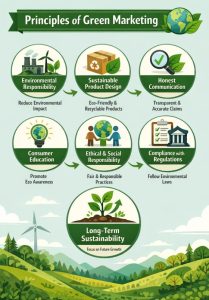
Green marketing is founded on the idea that business activities should not only aim for profit but also protect the environment and promote social well-being. As environmental awareness and sustainability concerns continue to grow, organizations are increasingly expected to adopt marketing practices that are environmentally responsible and ethically sound. The principles of green marketing provide a framework that guides businesses in designing, promoting, and delivering products and services in ways that minimize environmental harm while creating value for consumers and society.
- Environmental Responsibility: One of the core principles of green marketing is environmental responsibility. This principle emphasizes reducing the negative environmental impact of products and services throughout their life cycle, from raw material extraction to disposal. Businesses are encouraged to adopt eco-friendly production processes, reduce emissions, minimize waste, and conserve energy and water. By prioritizing environmental responsibility, organizations contribute to the protection of natural ecosystems and promote sustainable development.
- Sustainable Product Design: Sustainable product design is a key principle of green_marketing that focuses on creating products that are durable, recyclable, reusable, or biodegradable. This approach encourages the use of renewable and non-toxic materials while reducing excessive packaging. Designing products with sustainability in mind helps minimize resource consumption and waste generation, ensuring that products have a lower environmental footprint over their entire life span.
- Honest and Transparent Communication: Transparency and honesty are essential principles of green_marketing. Companies must provide accurate, clear, and verifiable information about the environmental attributes of their products and services. Misleading claims or exaggerated environmental benefits, commonly known as greenwashing, can damage consumer trust and brand credibility. Ethical communication helps consumers make informed purchasing decisions and strengthens long-term relationships between businesses and customers.
- Customer Education and Awareness: Green marketing also emphasizes educating consumers about environmental issues and sustainable consumption practices. Rather than simply promoting products, organizations should help customers understand how their choices affect the environment. By raising awareness about recycling, energy conservation, and responsible product use, green marketing encourages behavioral change that supports environmental sustainability.
- Compliance with Environmental Regulations: Adherence to environmental laws and standards is a fundamental principle of green marketing. Businesses must comply with government regulations related to pollution control, waste management, and product safety. Going beyond minimum legal requirements further demonstrates a firm’s commitment to environmental protection. Regulatory compliance reduces legal risks and reinforces an organization’s credibility and social responsibility.
- Social and Ethical Responsibility: Green marketing is closely linked to social and ethical responsibility. Companies are expected to consider the broader impact of their marketing decisions on society, including the well-being of communities, employees, and future generations. Ethical sourcing, fair labor practices, and community engagement are integral to this principle. By aligning environmental goals with social responsibility, green marketing supports inclusive and sustainable development.
- Long-Term Sustainability and Value Creation: Another important principle of green marketing is a long-term perspective on business success. Rather than focusing on short-term profits, green marketing encourages sustainable growth through innovation, efficiency, and responsible resource management. Creating long-term value for consumers, businesses, and the environment ensures organizational resilience and competitiveness in an increasingly sustainability-driven market.
The principles of green marketing emphasize environmental responsibility, sustainable product design, transparency, consumer education, regulatory compliance, ethical conduct, and long-term value creation. Together, these principles guide organizations in adopting marketing practices that balance economic objectives with environmental and social considerations. As global environmental challenges intensify, adhering to the principles of green marketing is crucial for building sustainable businesses and promoting a healthier planet for future generations.
Importance of Green Marketing
Green marketing has become increasingly important in today’s business environment due to growing environmental challenges and heightened public awareness of sustainability issues. As industrial activities and excessive consumption continue to contribute to pollution, climate change, and resource depletion, green marketing provides a responsible approach that encourages environmentally friendly production and consumption practices. By integrating environmental considerations into marketing strategies, organizations can help reduce ecological damage while promoting sustainable development.
Another major importance of green marketing lies in its ability to respond to the changing attitudes and preferences of consumers. Modern consumers are more informed and concerned about the environmental impact of the products and services they use. Many prefer brands that demonstrate environmental responsibility and ethical practices. Green marketing enables businesses to communicate their commitment to sustainability, build consumer trust, and influence purchasing decisions by highlighting eco-friendly attributes such as recyclability, energy efficiency, and reduced carbon footprints.
Green marketing also plays a significant role in conserving natural resources and promoting long-term sustainability. By promoting the efficient use of raw materials, waste reduction, recycling, and the adoption of renewable energy sources, green marketing fosters responsible resource management. This not only helps protect the environment but also ensures the availability of resources for future generations, making it essential for achieving sustainable economic growth. Additionally, green marketing is crucial for ensuring compliance with environmental regulations and mitigating business risks. Governments worldwide are enforcing stricter environmental laws to control pollution and protect ecosystems. Organizations that adopt green marketing practices are better positioned to comply with these regulations, avoid legal penalties, and enhance their corporate reputation. Proactive environmental responsibility also strengthens stakeholder confidence and public trust.
Finally, green marketing contributes to competitive advantage and long-term business success. Companies that genuinely implement green practices often enjoy a positive brand image, increased customer loyalty, and improved market positioning. Green marketing encourages innovation, cost efficiency, and sustainable business models, enabling organizations to remain competitive in an increasingly eco-conscious market. Therefore, the importance of green marketing extends beyond environmental protection; it is a vital strategy for balancing economic growth, social responsibility, and environmental sustainability.
Reference Articles:
- Jameel, S. T. (2022). Impact of green marketing strategies on tourist behaviour a study of select resorts of kerala.