Consumer awareness in the context of green marketing refers to the extent to which consumers understand, recognize, and evaluate the environmental attributes of products, services, and business practices. It involves knowledge about how products are produced, packaged, distributed, used, and disposed of, as well as awareness of their environmental impacts. For example, an environmentally aware consumer may consider whether a product is made from recycled materials, uses energy-efficient manufacturing processes, or comes in biodegradable or minimal packaging before making a purchase. In green marketing, consumer awareness goes beyond simple brand recognition; it includes the ability to distinguish genuinely eco-friendly products from conventional ones and to interpret environmental claims, labels, and certifications accurately, such as energy-efficiency labels on electronic appliances or eco-certifications on organic food products. Well-informed consumers are also more likely to question vague or misleading green claims-for instance, terms like “natural” or “eco-safe” that are not supported by clear evidence-and to seek reliable information from product labels or company disclosures. Consequently, consumer awareness plays a foundational role in shaping environmentally responsible consumption by enabling consumers to make informed choices that align with sustainability goals and by encouraging businesses to adopt transparent and authentic green marketing practices.
Why Consumer Awareness Is a Critical Factor in the Success of Green Marketing Strategies
Consumer awareness is considered a critical factor in the success of green marketing strategies because it directly influences how consumers perceive, evaluate, and respond to environmentally friendly products and messages. Green marketing initiatives rely heavily on consumers’ understanding of environmental issues, sustainable practices, and the credibility of green claims. When consumers are aware of the environmental benefits of a product, such as reduced carbon emissions, energy efficiency, or recyclable packaging, they are more likely to appreciate its value and incorporate it into their purchasing decisions. For example, consumers who understand the long-term cost and environmental benefits of energy-efficient appliances are more inclined to choose them over conventional alternatives, even if the initial price is higher. Higher levels of consumer awareness also reduce skepticism and resistance toward green marketing by enabling consumers to distinguish genuine sustainability efforts from misleading practices such as greenwashing. In this way, awareness builds trust between consumers and companies, strengthening brand credibility and loyalty. Moreover, informed consumers create market pressure that encourages businesses to invest in sustainable innovation and transparent communication. Therefore, consumer awareness acts as a driving force that connects green marketing strategies with actual consumer behavior, making it essential for achieving both commercial success and environmental sustainability.
The Role of Consumer Awareness in Green Marketing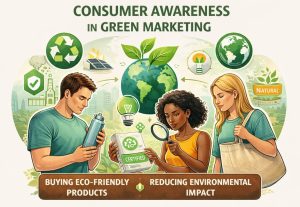
Green marketing has become a crucial strategy for businesses seeking to address growing environmental concerns while meeting evolving consumer expectations. At the core of green marketing lies consumer awareness, which determines how effectively environmental messages are understood, trusted, and translated into actual purchasing behavior. Consumer awareness shapes not only individual buying decisions but also influences corporate strategies and long-term sustainability efforts across industries.
Consumer awareness enables individuals to understand the environmental impact of products and services throughout their life cycle, from production and packaging to usage and disposal. When consumers are aware of issues such as carbon emissions, excessive energy consumption, and plastic pollution, they become more conscious of the consequences of their consumption choices. For instance, awareness of plastic waste has encouraged many consumers to shift from single-use plastic bags and bottles to reusable alternatives, contributing to reduced environmental pollution.
Informed consumers are more likely to make environmentally responsible purchase decisions and prioritize green products over conventional ones. Awareness increases consumers’ willingness to invest in eco-friendly options, even when they involve higher initial costs. A common example is the growing preference for energy-efficient LED lighting, as consumers understand that these products consume less electricity and offer long-term financial and environmental benefits compared to traditional incandescent bulbs.
Consumer awareness also plays a crucial role in building trust and minimizing the effects of greenwashing. As consumers become more knowledgeable, they are better equipped to evaluate environmental claims and identify misleading or exaggerated statements. This critical awareness encourages consumers to rely on credible eco-labels and certifications, such as energy efficiency ratings on electrical appliances, rather than vague claims like “environmentally friendly” that lack clear evidence.
Rising consumer awareness places increasing pressure on companies to act transparently and responsibly. Businesses are now expected to disclose accurate information about their environmental practices and demonstrate genuine commitment to sustainability. As a result, many organizations publish sustainability reports and adopt greener production processes to meet consumer expectations and protect their brand reputation.
Beyond purchasing behavior, consumer awareness in green marketing contributes to the adoption of sustainable lifestyles. Environmentally aware consumers are more inclined to practice recycling, conserve energy, and support brands that follow ethical and sustainable practices. For example, awareness of the environmental harm caused by fast fashion has led many consumers to favor durable clothing and brands that emphasize ethical sourcing and recycling.
Increased consumer awareness also drives market demand for green innovation. As awareness grows, consumer preferences shift toward sustainable products and technologies, encouraging businesses to invest in eco-friendly solutions. The rising awareness of air pollution and climate change, for instance, has significantly increased demand for electric and hybrid vehicles, motivating automobile manufacturers to expand their green product offerings.
Overall, consumer awareness is fundamental to the success of green marketing because it ensures that environmental initiatives lead to meaningful behavioral change rather than superficial promotion. Informed consumers foster accountability, influence market trends, and support long-term environmental sustainability. Therefore, consumer awareness serves as a vital link between green marketing strategies and sustainable development, benefiting both businesses and the environment.
Key Components of Consumer Awareness Related to Green Products and Services
Consumer awareness is a fundamental element in the adoption and success of green products and services. It enables consumers to understand environmental issues, evaluate sustainability claims, and make informed purchasing decisions. Consumer awareness in green marketing extends beyond basic knowledge; it encompasses several interconnected components that collectively shape environmentally responsible consumer behavior. The key components are discussed below.
- Environmental Knowledge and Understanding: Environmental knowledge refers to consumers’ awareness of environmental issues such as climate change, pollution, deforestation, and resource depletion. Consumers who understand how human activities affect the environment are more likely to value green products and services. For example, awareness of rising energy consumption and greenhouse gas emissions encourages consumers to choose energy-efficient appliances or renewable energy solutions.
- Awareness of Green Product Attributes: This component involves understanding the specific features that make a product or service environmentally friendly. These attributes may include the use of recycled or biodegradable materials, reduced energy or water consumption, non-toxic ingredients, and eco-friendly packaging. For instance, consumers who recognize the benefits of biodegradable packaging are more inclined to support brands that minimize plastic use.
- Knowledge of Product Life-Cycle Impact: Consumer awareness also includes understanding the environmental impact of a product throughout its life cycle-from raw material extraction and manufacturing to distribution, usage, and disposal. Consumers who consider life-cycle impacts are more likely to prefer durable, reusable, or refillable products that reduce waste. An example is choosing reusable shopping bags instead of single-use plastic bags.
- Understanding Eco-Labels and Certifications: Eco-labels and certifications play an important role in guiding consumers toward green products. Awareness involves not only recognizing these labels but also understanding their meaning and credibility. Consumers who are familiar with energy efficiency ratings or organic certifications can better identify genuinely green products and avoid misleading claims.
- Awareness of Corporate Environmental Responsibility: Consumers increasingly evaluate companies based on their environmental practices and ethical behavior. Awareness of corporate environmental responsibility includes understanding a company’s efforts in reducing emissions, managing waste, and sourcing materials responsibly. For example, consumers may prefer brands that publish sustainability reports or actively promote environmentally responsible production processes.
- Awareness of Personal Environmental Responsibility: This component reflects consumers’ understanding of how individual consumption choices contribute to environmental outcomes. When consumers recognize their role in environmental protection, they are more likely to adopt sustainable behaviors. For instance, awareness of water scarcity may encourage consumers to choose water-efficient appliances and reduce daily water usage.
- Ability to Critically Evaluate Green Claims: Critical evaluation skills enable consumers to assess the accuracy and authenticity of green marketing messages. This includes identifying greenwashing, comparing alternative products, and seeking reliable information. Consumers who can critically evaluate environmental claims help promote transparency and accountability in green marketing practices.
The key components of consumer awareness related to green products and services include environmental knowledge, understanding of green attributes, life-cycle awareness, familiarity with eco-labels, perception of corporate responsibility, personal environmental responsibility, and critical evaluation skills. Together, these components empower consumers to make informed and responsible choices, encourage businesses to adopt genuine sustainable practices, and support the overall effectiveness of green marketing initiatives.
How Consumer Awareness Affects Green Purchasing Behavior
Consumer awareness plays a decisive role in shaping green purchasing behavior by influencing how consumers perceive environmental issues, evaluate product information, and make responsible buying decisions. When consumers are aware of the environmental consequences of their consumption, they are more likely to prefer products and services that minimize harm to the environment. Awareness enables consumers to recognize the value of green attributes such as energy efficiency, recyclable materials, and reduced carbon emissions, which in turn increases their motivation to choose eco-friendly alternatives over conventional products. For example, consumers who understand the long-term environmental and cost benefits of energy-efficient appliances are more willing to purchase them despite higher initial prices.
In addition, consumer awareness enhances the ability to critically assess green marketing claims and reduces susceptibility to misleading information. Informed consumers are more likely to seek credible eco-labels, certifications, and transparent product information before making purchasing decisions. This critical evaluation builds trust in genuinely sustainable brands and discourages impulsive purchases based on vague or exaggerated environmental claims. As a result, consumer awareness strengthens the link between environmental concern and actual purchasing behavior.
How Consumer Awareness Influences Brand Preference for Eco-Friendly Products
Consumer awareness significantly influences brand preference for eco-friendly products by shaping how consumers perceive a brand’s environmental commitment, credibility, and long-term value. When consumers are knowledgeable about environmental issues and sustainability practices, they tend to favor brands that demonstrate genuine efforts to reduce environmental harm. Awareness enables consumers to evaluate factors such as sustainable sourcing, energy efficiency, ethical production, and waste reduction, which strengthens their preference for brands that align with their environmental values. For example, consumers who understand the environmental impact of plastic pollution are more likely to prefer brands that use recyclable or minimal packaging over those that rely heavily on single-use plastics.
Higher consumer awareness also enhances trust and loyalty toward eco-friendly brands. Informed consumers can distinguish authentic sustainability initiatives from superficial green marketing tactics, allowing them to develop stronger confidence in brands that provide transparent and verifiable environmental information. Real-world examples include consumers favoring household appliance brands that clearly display energy efficiency ratings or sustainability information, as these labels signal long-term cost savings and reduced environmental impact. This trust encourages repeat purchases and long-term brand loyalty. Moreover, consumer awareness influences brand preference by encouraging ethical and responsible consumption. Consumers who are aware of environmental and social issues often associate eco-friendly brands with higher quality, responsibility, and innovation. For instance, awareness of the environmental consequences of fast fashion has led many consumers to prefer clothing brands that promote durability, ethical sourcing, and recycling programs.
Does Higher Consumer Awareness Lead to Greater Willingness to Pay a Premium for Green Products?
Higher consumer awareness is often associated with a greater willingness to pay a premium for green products, but this relationship is complex and context-dependent. Environmentally aware consumers tend to better understand the long-term environmental and functional benefits of green products, such as reduced energy consumption, lower health risks, and decreased environmental harm, which can justify higher prices in their perception. For example, consumers who recognize the long-term cost savings and environmental benefits of energy-efficient appliances may be more willing to accept higher upfront prices. However, awareness alone does not guarantee a willingness to pay more. Factors such as income level, perceived product quality, trust in green claims, and availability of affordable alternatives significantly influence purchasing decisions. In some cases, even highly aware consumers may resist paying a premium if they suspect greenwashing or if the environmental benefits are not clearly communicated or personally relevant. Therefore, while higher consumer awareness can increase the perceived value of green products and positively influence willingness to pay, it must be supported by credible information, transparent marketing, and reasonable pricing to translate awareness into actual purchasing behavior.
How Consumer Awareness Shapes Attitudes Toward Sustainable Packaging
Consumer awareness plays a critical role in shaping attitudes toward sustainable packaging by influencing how consumers perceive the environmental consequences of packaging materials and waste. As consumers become more aware of issues such as plastic pollution, landfill overflow, and damage to marine ecosystems, they develop more favorable attitudes toward packaging solutions that minimize environmental harm, including those made from recyclable, biodegradable, or reusable materials. Awareness encourages consumers to view sustainable packaging not merely as a marketing feature but as a responsible environmental practice. However, this positive attitude is not without limitations. While environmentally aware consumers often express strong support for sustainable packaging, their attitudes may weaken when eco-friendly options compromise convenience, durability, or product protection. Additionally, skepticism can arise if packaging claims are vague or lack credible certification, leading to doubts about authenticity. Thus, consumer awareness shapes attitudes by increasing concern and preference for sustainable packaging, but these attitudes are strongly influenced by practicality, trust, and the perceived balance between environmental responsibility and functional performance.